
Doctors Aren't Leaving Because We Chose the Wrong People
May 31, 2026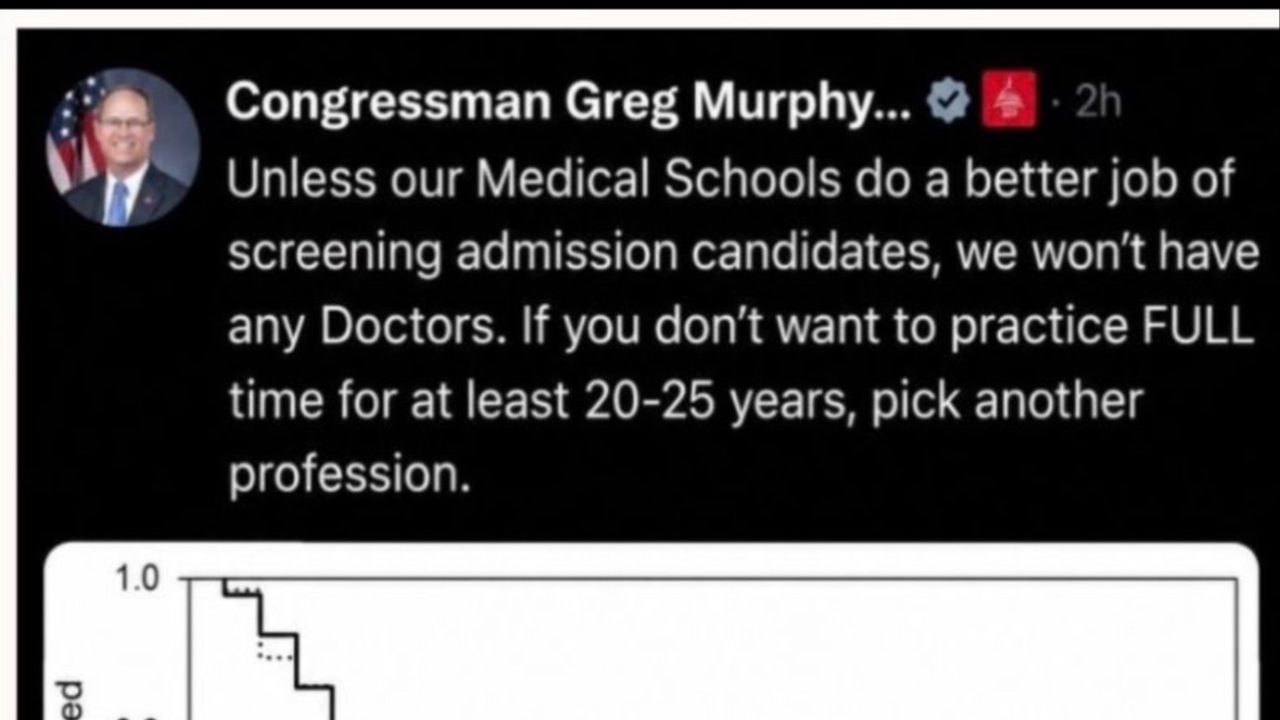
I saw a social media post recently from a physician-congressman that left me staring at my screen and fuming for quite a while.
His argument was straightforward: If medical students don't intend to practice full-time for 20-25 years, then they shouldn't become doctors at all.
The post included data showing that women physicians leave clinical practice earlier than men.
And the conclusion seemed to be that medical schools need to do a better job screening applicants.
Let's pause there.
Because that's a remarkable conclusion.
We have record levels of physician burnout. A worsening physician shortage. An epidemic of moral injury. Increasing rates of depression, anxiety, and suicide among physicians.
Entire online communities filled with doctors trying to figure out how to stay in medicine without sacrificing themselves to it.
And somehow the takeaway is: Maybe we're admitting the wrong people.
Not:
Maybe the system is broken.
Not:
Maybe the working conditions are unsustainable.
Not:
Maybe we've built a profession that routinely consumes the very people it depends on.
No. Apparently the problem as Dr. Murphy sees it is who gets the medical school seats.
Medicine's Favorite Trick
Medicine has always had a favorite trick.
When something goes wrong, individualize the problem.
Burned out? Work on your resilience.
Exhausted? Improve your self-care.
Drowning? Take a mindfulness course.
Leaving? Maybe you just weren't ever committed enough.
It's an incredibly effective strategy because it protects institutions from having to examine themselves.
The system remains unquestioned.
The physician becomes the problem.
Again.
The Gender Part Nobody Wants to Say Out Loud
Let's talk about the women physicians referenced in the graph.
The implication seems to be that women are leaving too early and they’re somehow the problem.
But here's what fascinates me: Nobody asks why they’re leaving.
Nobody asks whether women physicians are responding rationally to conditions that have become increasingly unreasonable.
Nobody asks what happens when a profession was designed around assumptions from a different era. From a time when most physicians were male and had wives at home to do literally everything else so the physician could just be a doctor 24/7/365.
Nobody asks what happens when physicians are expected to function as though caregiving responsibilities don't exist.
Nobody asks why flexibility is often treated as a lack of commitment.
Instead, we look at the outcome and conclude:
"We should have screened them better." “We never should have let them in the door.”
Imagine applying that logic anywhere else. In any other industry or profession.
If an employer had trouble retaining workers, would we assume the solution was finding people willing to tolerate more dysfunction and unsustainable workplace conditions?
Or would we ask why people keep leaving?
What Counts as Commitment?
This is the part that bothers me most.
The suggestion that physicians who leave clinical medicine after 10 or 15 years somehow lacked commitment.
Let's be serious.
Nobody spends four years in medical school. Three to seven years in residency. Hundreds of thousands of dollars. Thousands of nights studying. Years missing holidays, birthdays, and family events...
...because they aren't committed.
The physicians leaving medicine are often the most committed people I know.
Many stayed years longer than they should have.
Many kept going long after the profession stopped loving them back.
The Generational Shift That's Making People Uncomfortable
I think what's really happening is something else.
A generation of physicians is questioning assumptions previous generations accepted.
The assumption that medicine deserves unlimited access to your life. The assumption that self-sacrifice is inherently virtuous. The assumption that burnout is simply the price of admission. The assumption that leaving a harmful environment represents failure.
Younger physicians are looking at these ideas and saying:
"No."
And frankly, I think that's healthy.
Because a profession that can only survive if people are willing to sacrifice themselves indefinitely doesn't have a physician problem. It has a design problem.
The Question We Should Be Asking
If physicians are leaving medicine earlier than expected, I don't want to know how we can identify people willing to endure more.
I want to know why so many intelligent, compassionate, highly trained professionals are reaching the same conclusion - that they can’t stay in clinical medicine.
What are they seeing? What are they experiencing? What are they trying to tell us?
Because when large numbers of people walk away from something they once worked extraordinarily hard to achieve, the first question shouldn't be:
"What's wrong with them?"
The first question should be:
"What is wrong with the thing they're leaving?"
And the fact that we're still asking the first question may explain exactly why the problem keeps getting worse.
Coaching has helped me personally, so I trained to become a coach so that I can share the same tools with you.
Book a free introductory session now.
Stay connected with news and updates!
Join our mailing list to receive the latest news and updates from our team.
Don't worry, your information will not be shared.
We hate SPAM. We will never sell your information, for any reason.
